
Guide · reading time ~7 min
Odds in plain English
Probability measures how likely an event is from 0 (impossible) to 1 (certain). Casino-style games package that into bets and paytables.
Three useful ideas
- 01Equally likely outcomes
A fair six-sided die has six faces; each has probability 1/6 if the die is fair. - 02Independence
If spins or rolls do not influence each other, past results do not change the next probability. - 03Expected value
Average return per unit stake over a long run, before talking about streaks you feel at the table.
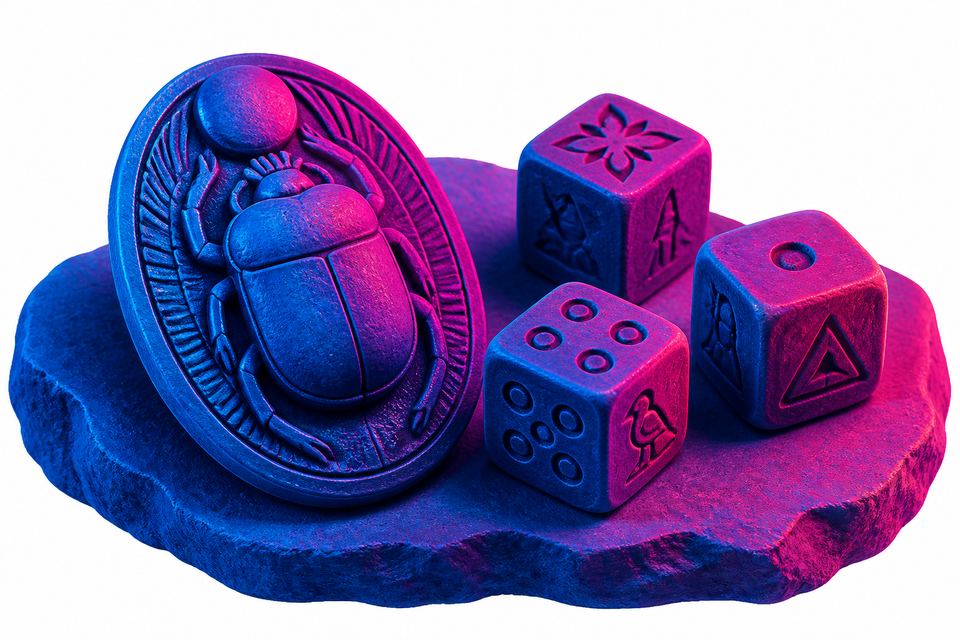
A worked die example
Probability of rolling a 4 on one fair die: 1/6 ≈ 16.7%. Probability of not rolling a 4: 5/6. These add to 1.
Combining events
For independent events, multiply. Two fair coins both landing heads: 1/2 × 1/2 = 1/4.
| Event | Probability |
|---|---|
| Single-zero roulette, straight-up one number | 1/37 ≈ 2.70% |
| Fair coin heads | 1/2 = 50% |
| Blackjack natural (approx., six-deck order of magnitude) | about 4.8% depending on composition |
Payouts are separate from probabilities. A bet can pay 35 to 1 while occurring 1 in 37 times; the gap is the house edge in real-money games. Here you only move virtual coins.
What probability is not
- It does not guarantee a hit after a quiet run.
- It does not make a “system” overcome a negative expectation in real-money play.
- It does not turn free social play into training that predicts cash results.